We have been supporting the family-owned company Trob in developing its brand since 2020. At the beginning, we jointly defined the communication strategy.

The term "communications strategy" is still new and challenging for many small and medium-sized enterprises (SMEs) to grasp. However, it forms the foundation for long-term, successful and authentic communication. A communications strategy defines which conceptual considerations and measures are necessary to achieve communication goals. It defines which target groups a company communicates with, when, and through which channels. Targeted communication concepts are developed on this basis.
Communications measures are only effective when they are coordinated. A clear strategy provides the necessary overview and enables the targeted use of budgets and resources. It helps to address relevant target groups and successfully position new products. With a well-thought-out communications strategy, companies can continuously improve their communications and thus strengthen their market position in the long term.
The content of a communications strategy varies depending on the company, products, and target groups. For example, the approach of an online fashion retailer differs significantly from that of an automotive component supplier.
In medium-sized businesses, authentic stories often already exist and don't need to be invented. The key is to communicate these narratives clearly and credibly.
We support our clients in discovering and defining their individual stories and translating them into appealing applications and designs. One example of this is our client Trob, a second-generation family-run business from Bavaria. Trob is the market leader and specialises in precision manufacturing – a so-called hidden champion in its industry.
At the beginning of our collaboration with Trob, we examined existing communication measures as well as the strengths and weaknesses of competitors in the German market. This research enabled us to identify relevant market and action areas for future positioning. We prepared the results for our clients and used them as the basis for two workshops in which target groups and messages were clearly defined. Insights into the tone, imagery, and topic structure of the industry and the competition were then incorporated into the design phase.
In several interviews with management and a workshop with employees, we developed a comprehensive description of the company, its industry, the market, and its technology. We defined special features, unique selling propositions, target groups, and Trob's strategy and vision. We summarised these findings in a clear positioning statement.
Trob manufactures precision parts of the highest quality and offers solutions for processing materials down to 5 micromillimeters in size. All production steps are carried out independently and under one roof. The company leverages its comprehensive expertise across industries and develops customised manufacturing processes for leading global companies in the automotive, mechanical engineering, electronics, and medical sectors.
Based on extensive research, clear communication goals were defined that make the success of the measures measurable. For effective communication, it is crucial to define precise goals. These could, for example, include increasing the awareness of a product or several product groups by a certain percentage within a specified period. The objectives are explicitly aimed at defined customer groups or industries and relate to a clearly defined geographical area, such as nationally.
Setting objectives is a challenging task. Unlike investments in material goods such as machinery, the success of communication and design measures cannot be calculated based on a return on investment (ROI). Nevertheless, it is necessary to assign concrete monetary expectations or measurable increases in contacts and contact times to the measures.
The brand is to achieve a new, more modern brand image within one year. The grinding, milling, EDM, and turning product groups will be positioned and promoted to buyers in the automotive, medical, electronics, and mechanical engineering sectors at the national level and via digital channels.
Different target groups require tailored messages at the correct times. To ensure the long-term success of brand communication and to create targeted content, the company has defined eight target groups. Central and complementary messages were developed for each of these groups and assigned to the respective communication channels.
Trob is one of the most attractive employers in the mechanical engineering sector in Bavaria. The company pursues a modern approach, cultivates an open and liberal corporate culture, and values family-friendliness. Employees benefit from a wide range of advancement opportunities, such as the chance to transfer between different production areas.
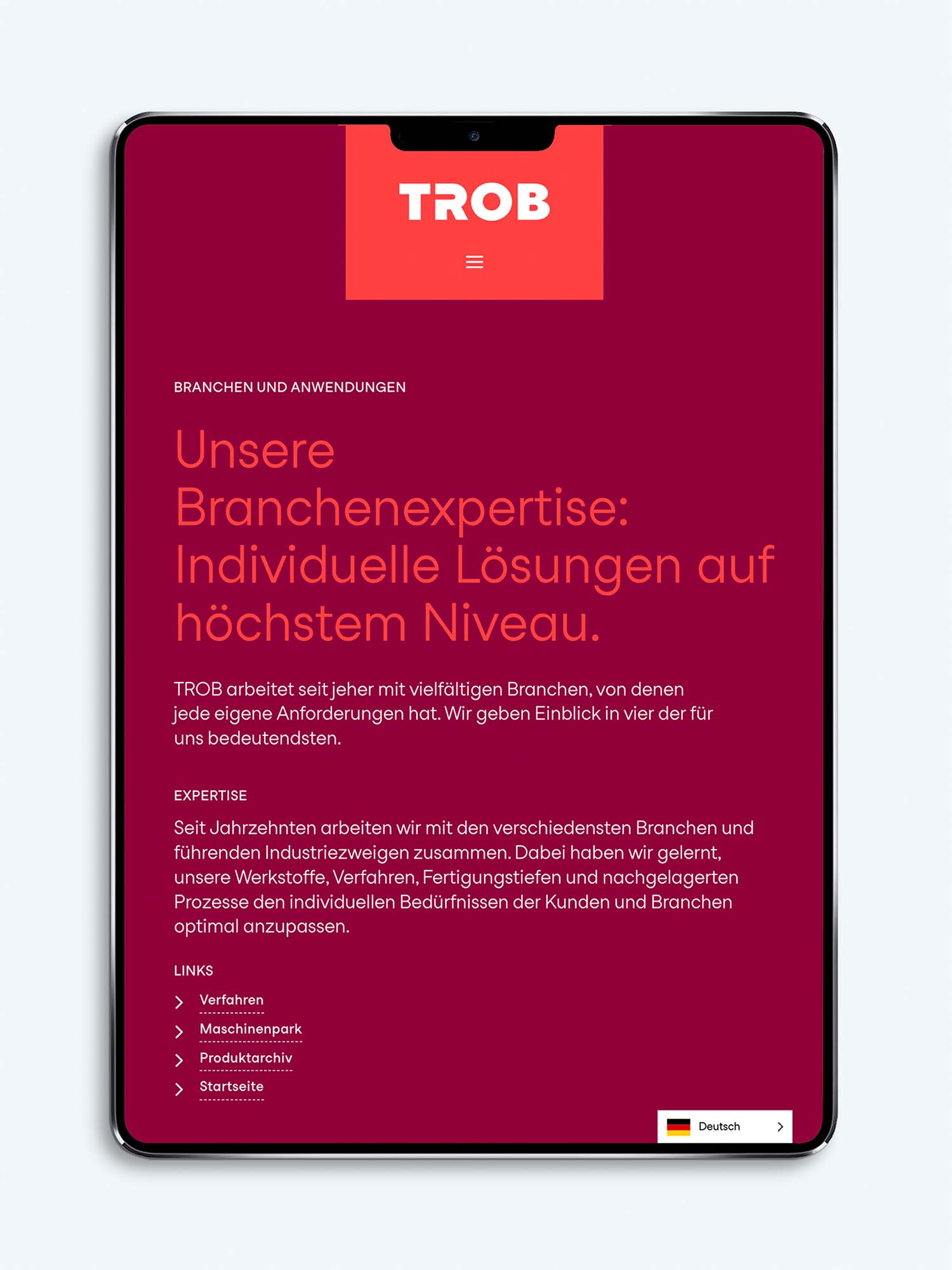
The brand's benefits were formulated specifically for our client's target group, as different groups have different needs. The benefits can generally be divided into three levels: functional, emotional, and symbolic.
To protect our client's competitive advantage, we briefly summarise these benefits here:
Not only what we say, but how we say it shapes the tone of voice.
Since communication strategies often seem technical and complex, we use methods that convey content quickly and understandably. One of these is projecting the company's character onto a person to enable a vivid description. This is how the persona Torsten Trob, who embodies the company, was created.
Torsten Trob is a highly specialised technician who combines practical experience and research. He is passionate about his field – from small challenges to big visions. He passionately explains complex topics in a simple, easy-to-understand, and engaging way. As a person, Torsten is down-to-earth and approachable. He values interaction with others and enjoys energetic, positive discourse. He is also resourceful and implements ideas quickly.
Based on research, positioning, target group definition, messaging, benefits, and USP, we developed a twelve-month operational plan, which we successfully implemented. The services provided included: